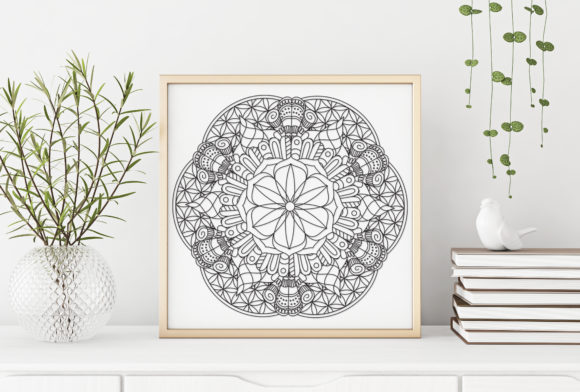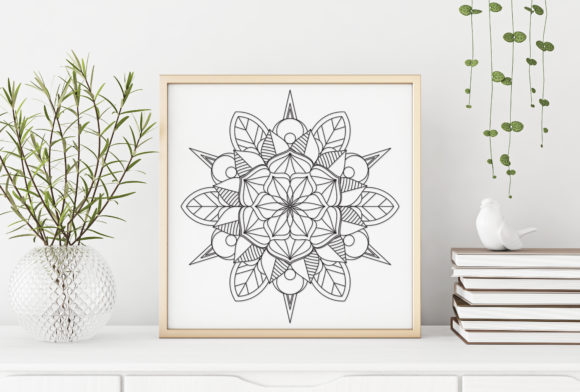
Mandala Art Circular: A Creative Compass
At its core, Mandala Art Circular is a visual framework rooted in symmetry, repetition, and centered composition — not just as decoration, but as a tool for focus, structure, and meaning-making. Unlike linear or grid-based layouts, it organizes elements around a central point, radiating outward in balanced layers. This isn’t about rigid templates; it’s about intentionality — how space, rhythm, and relationship shape perception and engagement.
Why It Resonates Across Roles
What makes Mandala Art Circular uniquely adaptable is how it shifts function depending on who’s using it — and why. A teacher doesn’t need the same features as a branding consultant, nor does a journaling hobbyist require the same precision as a print-on-demand designer. Its value isn’t fixed — it’s contextual.
For Beginners and Mindful Practitioners
If you’re new to intentional design — or simply seeking calm through creativity — Mandala Art Circular offers low-barrier entry. You don’t need software or formal training to start: a compass, paper, and pencil are enough. The circular form naturally guides your hand, reducing decision fatigue. Each layer becomes a gentle prompt: “What belongs at the center? What supports it? What expands from it?”
Many use it for reflection — placing a personal value (like “curiosity” or “resilience”) in the center, then surrounding it with habits, people, or resources that nurture it. Others sketch daily mandalas as grounding rituals — no rules, no judgment, just presence. Here, ease of use and emotional resonance matter more than pixel-perfect symmetry.
For Educators and Workshop Facilitators
In classrooms or community spaces, Mandala Art Circular serves as a nonverbal thinking scaffold. Students map ecosystems, historical cause-and-effect, or story arcs radially — revealing connections that linear outlines often obscure. One middle-school science teacher uses it to diagram water cycles, placing the sun at the center and tracing evaporation, condensation, and precipitation outward in concentric bands.
Educators prioritize clarity, adaptability, and inclusivity. A mandala drawn by hand, digitally, or even with natural materials (stones, leaves, yarn) carries equal weight. The format invites diverse learning styles — visual, kinesthetic, spatial — without requiring technical fluency. For them, Mandala Art Circular isn’t about aesthetics first; it’s about cognitive accessibility.
For Designers and Visual Communicators
Professionals who craft presentations, infographics, or brand systems often turn to Mandala Art Circular when hierarchy needs nuance. Think beyond pie charts: a product roadmap where vision anchors the center, core features orbit closely, and future integrations extend farther out. Or a values statement where ethics sit central, supported by policies, team practices, and customer touchpoints in successive rings.
Here, flexibility and fidelity matter. Can the structure scale across formats — from a social media carousel to a printed annual report? Does it hold up in grayscale or high-contrast mode? Designers test Mandala Art Circular not for beauty alone, but for communicative resilience — whether it clarifies or complicates the message.
For Small Business Owners and Marketers
A local wellness studio used Mandala Art Circular to rethink their service menu. Instead of listing offerings linearly (“Yoga, Massage, Nutrition”), they placed “Client Well-being” at the center, then grouped services by intention: “Grounding” (yoga, breathwork), “Restoration” (massage, herbal consults), and “Growth” (workshops, 1:1 coaching). Clients responded more strongly — the structure revealed purpose, not just products.
For these users, Mandala Art Circular functions as both strategy tool and client-facing asset. They care about speed (can it be sketched in a 30-minute planning session?), commercial value (does it strengthen messaging or simplify onboarding?), and long-term usefulness (will it still make sense six months from now?). It’s rarely about perfection — it’s about alignment.
For Publishers and Content Creators
Bloggers and newsletter writers sometimes hit walls with traditional outlines — especially when covering layered topics like mental health, sustainability, or creative process. Mandala Art Circular helps them identify core themes and supporting angles without forcing artificial sequence. One writer on mindful tech use placed “Attention” at the center, then built rings around digital boundaries, tool selection, habit stacking, and community accountability.
They value narrative flow over geometric precision. A slightly irregular circle can feel more human — and more trustworthy — than a sterile, algorithmic layout. Their priority is resonance: does this structure help readers *feel* the relationships between ideas, not just see them?
What to Consider Before You Begin
Not every project benefits from circular logic. If your goal is chronological storytelling, step-by-step instructions, or comparative analysis (e.g., “Feature A vs. Feature B”), a linear or tabular approach may serve better. Mandala Art Circular shines when:
- You’re mapping relationships, not sequences;
- Balance, harmony, or centrality are meaningful to your message;
- You want to invite contemplation, not just consumption;
- Your audience responds to visual metaphor — not just data.
Also consider your medium. Hand-drawn mandalas carry warmth and authenticity — ideal for journals, workshops, or intimate branding. Digital tools offer repeatability and scalability — essential for reports, dashboards, or multi-platform content. Neither is “better”; they serve different intentions.
Getting Started Without Overthinking
You don’t need special tools. Try this in under five minutes:
- Draw a small circle in the center of a blank page. Label it with your core idea — one word or short phrase.
- Add a second ring. What directly supports or enables that idea? List 3–5 elements.
- Add a third ring. What extends from those supports — outcomes, examples, or next steps?
- Step back. Does the flow feel intuitive? If something feels forced, move it — or leave it out.
That’s it. No symmetry police. No grading. Just structure that serves your thinking — not the other way around.
Mandala Art Circular isn’t a trend or a trick. It’s a quiet invitation: to slow down, clarify what matters most, and build outward from there — with intention, not inertia.