Moon Glyphs Kit: A Practical Guide for Symbol-Based Lunar Practice
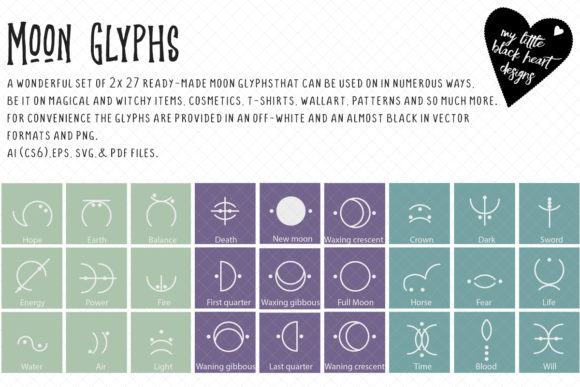
The Moon Glyphs Kit is a curated set of symbolic representations—hand-drawn or digitally rendered glyphs—designed to support lunar observation, reflection, and personal tracking. Unlike generic moon phase calendars or app-based reminders, it centers on visual language: each glyph corresponds to a specific lunar phase, node position, or energetic quality (e.g., “Waxing Crescent – Intention Seed,” “Balsamic – Release Threshold”). It’s not software, not a subscription service, and not a pre-filled journal—it’s a flexible, tactile resource meant to be interpreted, adapted, and integrated into existing practices.
What Sets the Moon Glyphs Kit Apart
Its distinction lies in its intentional minimalism and symbolic fidelity. Most lunar tools prioritize utility—tracking dates, calculating rise times, or generating notifications. The Moon Glyphs Kit prioritizes resonance. Each glyph is designed with attention to historical motif, astrological nuance, and intuitive readability—not as decoration, but as a cognitive anchor. For example, the glyph for the North Node in Cancer doesn’t just mark an astronomical point; its curved, cradling form invites reflection on emotional roots and inherited care patterns. This isn’t data visualization—it’s meaning visualization.
It also avoids prescriptive interpretation. There are no fixed “meanings” printed alongside each symbol. Instead, the kit includes contextual notes—brief, sourced references to mythic parallels, seasonal correlations, and cross-cultural lunar associations—leaving room for the user’s own associations to develop over time. That makes it especially useful for people who value autonomy in their practice: therapists integrating lunar awareness into client work, educators designing experiential curricula, or writers building symbolic frameworks for creative projects.
How It Fits Alongside Other Lunar Resources
Consider how the Moon Glyphs Kit relates to more common tools:
- Digital lunar apps excel at precision—exact timings, location-specific visibility, eclipse alerts—but often flatten symbolism into brief pop-up definitions. The Moon Glyphs Kit complements them by offering a non-screen-based layer of interpretation you can sketch beside a weather note, tape into a field notebook, or use to annotate a printed star chart.
- Printed moon phase journals provide structure through dated pages and prompts. The Moon Glyphs Kit doesn’t replace that scaffolding—it enhances it. You might stamp or draw a glyph at the top of a journal entry, then let its shape guide your writing without relying on pre-written questions.
- Astrology software calculates complex configurations (e.g., Moon conjunct Chiron in Pisces), but rarely translates those into accessible visual shorthand. The Moon Glyphs Kit doesn’t compute aspects—but it gives you a consistent, portable way to represent recurring themes across months or years, helping spot subtle patterns that raw data alone may obscure.
In short: it’s not a standalone system, nor is it meant to be. It’s a bridge between astronomical fact and subjective experience—designed to be used *with* other tools, not instead of them.
Strengths and Real-World Use Cases
Where the Moon Glyphs Kit shines is in consistency, portability, and adaptability across contexts:
- Educators use individual glyphs as discussion prompts in astronomy or mythology units—asking students to compare the Moon Glyphs Kit’s “Full Moon – Clarity Threshold” with traditional depictions like the Greek Selene or Hindu Chandra.
- Clinical practitioners incorporate glyphs into mood-tracking logs—not to pathologize cycles, but to help clients notice rhythms without judgment. One therapist reported that clients who resisted “moon talk” engaged readily when invited to choose or modify a glyph to match how they felt that week.
- Artists and designers treat the kit as a reference library for symbolic vocabulary—referencing glyph proportions, line weight, and negative space when developing original iconography for zines, tarot decks, or environmental installations.
Its physical format (typically high-quality printable PDFs or letterpress-printed cards) supports repeated, low-friction use. You don’t need to log in, update permissions, or troubleshoot sync errors. That reliability matters during travel, retreats, or periods when screen time feels counterproductive.
Tradeoffs and Limitations to Consider
No tool serves every need—and the Moon Glyphs Kit has clear boundaries. It does not calculate local moonrise/moonset times. It does not generate horoscopes or interpret transits. It does not include audio guidance, guided meditations, or community features. If your primary goal is daily motivational nudges or real-time celestial updates, this kit won’t fulfill that function.
It also assumes a baseline willingness to engage interpretively. Someone seeking clear, step-by-step instructions (“Do this on the First Quarter”) may find its open-endedness disorienting at first. Likewise, users who prefer highly personalized, algorithm-driven insights may miss the dynamic responsiveness of digital tools. The Moon Glyphs Kit rewards patience and repetition—it deepens with use, rather than delivering immediate utility.
Another practical consideration: while the glyphs are designed for clarity, their effectiveness depends on how you integrate them. Using them once in isolation rarely yields insight. Their value emerges over weeks or months—when you begin to recognize how the same glyph appears alongside different life events, or how your interpretation of “Waning Gibbous – Integration” shifts after a major transition.
When It’s Likely the Right Fit
The Moon Glyphs Kit tends to align well with people who:
- Already track lunar cycles in some form (via app, journal, or observation) and want to add symbolic depth—not replace their current method;
- Prefer tangible, analog resources for reflective practice and find screens disruptive to contemplative states;
- Work across disciplines—blending astronomy, psychology, art, or education—and need a neutral, adaptable symbolic vocabulary;
- Value consistency over novelty: they’d rather refine one thoughtful tool than cycle through multiple apps or systems;
- Are comfortable holding ambiguity—using symbols as starting points, not definitive answers.
It’s also well-suited for collaborative settings where shared visual language matters: a team designing a wellness program, a study group exploring cultural cosmologies, or a family creating seasonal rituals together. Because the glyphs avoid culturally exclusive terminology (e.g., no mandatory Sanskrit or Norse terms), they serve as inclusive entry points—not gateways requiring prior expertise.
When Another Option May Serve Better
You may want to look elsewhere if:
- You need precise, location-aware timing data—especially for photography, navigation, or observational astronomy;
- Your practice relies heavily on predictive elements (e.g., “This Full Moon will activate my 7th house—here’s what to expect”);
- You prefer guided structure: daily prompts, voice-led reflections, or built-in accountability features;
- You’re new to lunar awareness and want foundational explanations before engaging symbolically;
- You require accessibility accommodations beyond standard print contrast (e.g., screen reader compatibility, audio descriptions, or braille versions)—the Moon Glyphs Kit, as currently offered, is primarily visual and tactile.
None of these factors invalidate the kit—they simply clarify scope. Choosing a resource isn’t about finding “the best” tool overall, but identifying which one fits your current goals, habits, and constraints.
Making a Grounded Decision
Evaluating the Moon Glyphs Kit isn’t about measuring it against an ideal—it’s about asking honest questions: What do I already do well? Where do I feel friction or repetition? What kind of support helps me stay present, not distracted? If you’ve tried digital trackers but keep abandoning them mid-month, or if you collect moon-themed art but rarely connect it to your own rhythm, the Moon Glyphs Kit may offer the quiet continuity you’re missing. If, however, you rely on live data or thrive on external guidance, pairing it with another resource—or choosing something else entirely—is equally valid.
There’s no universal “right” lunar practice. There’s only what meets you where you are—today, with the materials you have, in the context you inhabit. The Moon Glyphs Kit offers one thoughtful, grounded option within that landscape: simple in form, rich in implication, and respectful of both astronomical reality and human subjectivity.